Ube bayan
Our Farm
Nestled in Tapaz, in Capiz province, in the Philippines,
Our farm is located on the outskirts of a village run by the NGO Gawad Kalinga, built in 2014 after Typhoon Yolanda.
Ube bayan
Tapaz


Among the 28 families who were rehoused there,
Many still have a precarious source of income; mainly one-off, very physical missions paid at the minimum daily rate (400 pesos, around €5.50), during the planting and harvesting periods of rice (2x2 months).
The farm aim's to provide them with a stable income for the other 8 months of the year.
10,000 Ube plants planted provide a sustainable income for 15 farmers from the community.
They are also co-owners of the farm, organized as a cooperative.


Women's empowerment
In the Philippines, patriarchy is still predominant and many women, especially in rural areas, have the primary role of taking care of the home and children.
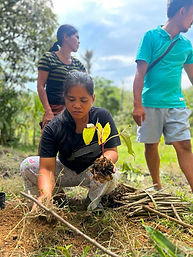
We have organized our farm to allow women to be involved and take responsabilities in the project; our plantations are located 200 m from the houses, there is a flexible schedule, a space to allow children to play safely and mothers to breastfeed, and finally, trust and support to manage the different units of the farm.
As a result, all the farm's workshops are run by women and women make up 69% of the members!



Biodiversity protection
Quality harvests begin with a healthy environment.
Our Ube is planted by hand, using techniques adapted to the soil type.
Following the principles of agroecology and peasant farming, we use only our own vermicompost and our own fermentations as natural fertilizers, to preserve local biodiversity and guarantee healthy, pesticide-free products.
In recognition of our practices, our plantations are currently undergoing organic certification - EU 2018/848